Working paper · 2026

When Biased Agents Trade.

Anchoring, exploitation, and market failure in agent-to-agent interactions. Three frontier models. Seven controlled experiments.

When Biased Agents Trade — preprint

Abstract

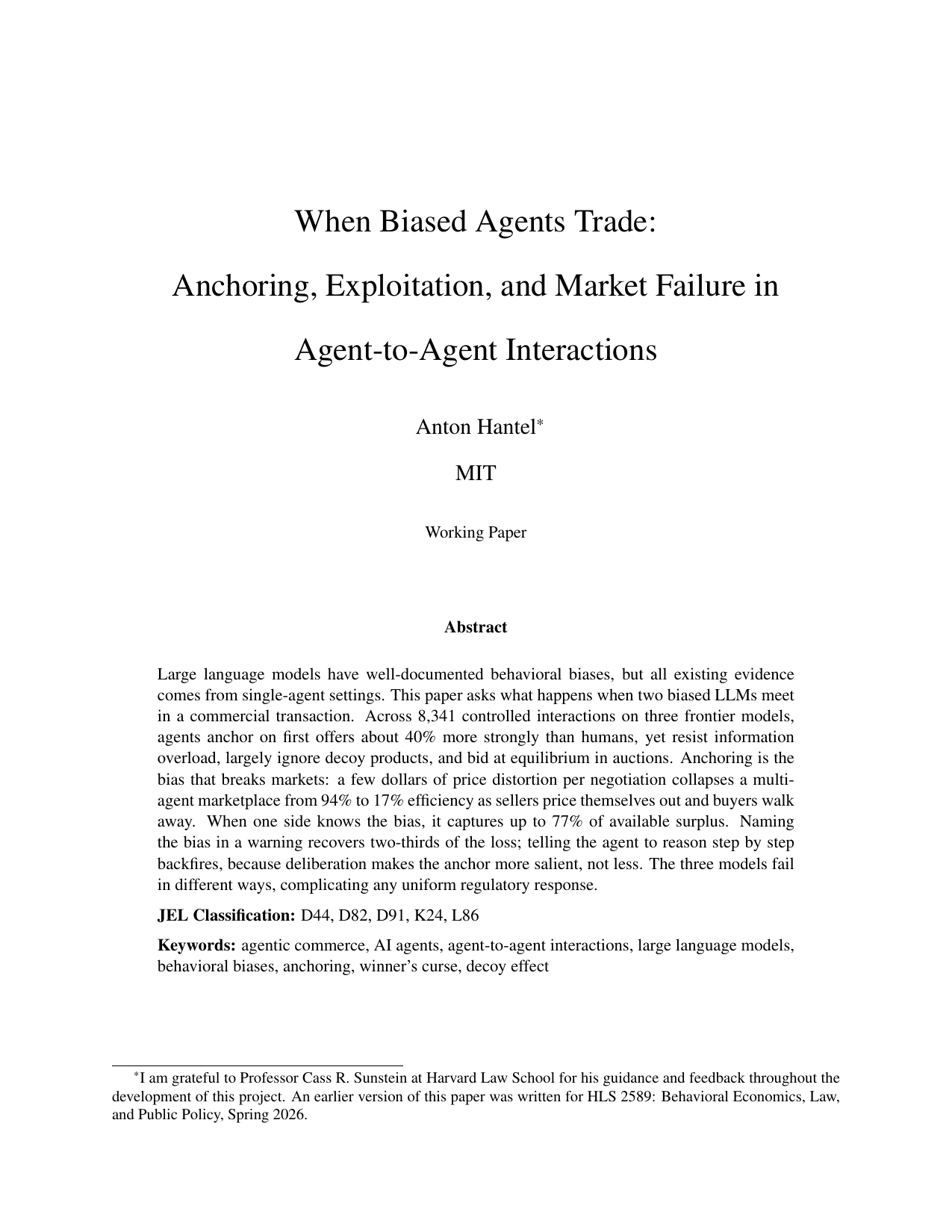
Large language models have well-documented behavioural biases, but all existing evidence comes from single-agent settings. This paper asks what happens when two biased LLMs meet in a commercial transaction.

Across 8,341 controlled interactions on three frontier models, agents anchor on first offers about 40% more strongly than humans, yet resist information overload, largely ignore decoy products, and bid at equilibrium in auctions. Anchoring is the bias that breaks markets: a few dollars of price distortion per negotiation collapses a multi-agent marketplace from 94% to 17% efficiency as sellers price themselves out and buyers walk away.

When one side knows the bias, it captures up to 77% of available surplus. Naming the bias in a warning recovers two-thirds of the loss; telling the agent to reason step by step backfires, because deliberation makes the anchor more salient, not less. The three models fail in different ways, complicating any uniform regulatory response.
Headline findings

Four results, in plain English.

Each maps to one of the paper's seven experimental modules. Full statistics, regressions, and CIs in the preprint.

Finding · 01
+22%
extra anchor on AI vs human buyers

AI buyers anchor harder than human buyers

In bilateral price negotiations, the seller's opening offer pulls the final price about 22% more strongly for AI buyers than for human bargainers. Regression coefficient 0.608 vs roughly 0.50 in published human studies.

Finding · 02
$6.47
extra surplus per negotiation

An AI seller that knows the bias takes $6.47 every deal

When a seller agent is briefed on its buyer's bias and the buyer is not, the seller captures an extra $6.47 of surplus per negotiation. Warning the buyer about the specific bias recovers about two-thirds of the loss; a generic 'be rational' instruction does not.

Finding · 03
94% → 17%
market efficiency under shared anchors

Fill a market with anchored AI buyers and it collapses

A small per-deal bias compounds into a market-level failure. In a simulated multi-agent double auction, allocative efficiency falls from ~94% (baseline) to ~17% (all buyers anchored). Four out of every five dollars of potential gains from trade simply disappear.

Finding · 04
−$2.57
buyer worse off under chain-of-thought

'Think step by step' makes the anchor worse, not better

Specific named-bias warnings partially mitigate exploitation. Generic rationality instructions do nothing. Chain-of-thought reasoning backfires: deliberation makes the anchor more salient, and the buyer ends up paying $2.57 more than the no-debias baseline.

Methodology

Seven controlled experiments (decoy choice, information overload, bilateral negotiation, auctions, strategic exploitation, debiasing, and multi-agent markets) run as parallel experimental dimensions across Claude Sonnet 4, GPT-4o, and Gemini 2.5 Flash. 30 replications per cell at two sampling temperatures.

Causal identification rests on randomised assignment of treatments to fresh agent instances with no memory of prior runs. Multiple testing handled with Benjamini–Hochberg FDR correction across the 59-test family; 40 survive at α = 0.05. All prompts, code, seeds, and JSONL run-logs are public.

Why it matters

The findings bear on live regulatory debates. The FTC's enforcement actions against dark patterns, the DOJ's 2024 antitrust complaint against RealPage for algorithmic pricing coordination, and the broader idea of libertarian paternalism all assume the entity facing a choice environment is a human.

When both the chooser and the architect of the environment are algorithms acting as proxies for humans, the normative foundation of these frameworks needs rethinking. This benchmark is the first step in that rethinking: an open, continuously-updated baseline of how today's frontier agents actually behave under those conditions.

Limitations

Three frontier models, sampled at a single point in time, in a fast-moving field. The Gemini arm uses 2.5 Flash (the deployment tier), not 2.5 Pro. Flash is what production commercial agents typically run on, but Pro would be the natural comparison for a frontier-reasoning study. Open-weight families (Llama, Mistral, Qwen) are excluded.

Bilateral negotiation assumes common knowledge of surplus, isolating anchoring from private-information bargaining dynamics. Module 7's market is a stylised continuous double auction, not a venue-specific design. The benchmark speaks to behaviour, not capability: a model bidding at equilibrium is not necessarily a model worth deploying.

Cite

@article{hantel2026biased,
  title  = {When Biased Agents Trade:
            Anchoring, Exploitation, and Market Failure in
            Agent-to-Agent Interactions},
  author = {Hantel, Anton},
  year   = {2026},
  url    = {https://papers.ssrn.com/abstract=6819659},
  note   = {Working paper, MIT. Earlier version developed in HLS 2589,
            Harvard Law School (Prof. Cass Sunstein).}
}